5 ★ (0)
4 ★ (0)
3 ★ (0)
2 ★ (0)
1 ★ (0)

Portopia Renzoku Satsujin Jiken (ポートピア連続殺人事件), otherwise known as "The Portopia Serial Murder Case," is an game that was created single-handedly by Yuji Horii (Person) and was initially published in Japan by Enix on cassette tapes for the NEC PC-6001 computer in June 1983. The title was later ported to several other Japanese computers but obtained mainstream success with the Famicom version developed by Chunsoft (Company) that was released on November 29, 1985. A remake of Portopia was created again by Chunsoft along with Armor Project (Company) in 2001 that was released by Enix for Japanese mobile phones, specifically the Java-based i-αppli service, as part of their "Unsolved Case Files" brand of mobile games. The remake featured completely new graphics as well as an added save function and was later re-released by Square Enix (Company) on the ezplus and J-SKY services in 2003, under the "Yuji Horii Theater" brand name. Another remake was again created for mobile phones in 2005 that featured a redone presentation. The game is the first of three adventure games created by Yuji Horii, which were retroactively called the Yuji Horii Mysteries (Franchise) trilogy, that also includes 1984's Hokkaidou Rensa Satsujin: Ohotsuku ni Kiyu!! and Karuizawa Yuukai Annai (Game) from 1985.
The game is an investigative adventure title in which the player must solve a murder mystery by searching for clues, exploring different areas, interacting with characters, and solving item-based puzzles all using the game's text parser or the verb window in the console release. The title allows for open-ended exploration where the player can solve the case in a multitude of ways. Environments are interactive, with the player being able to take out a magnifying glass to examine something or a hammer to hit an object. There are interactive elements as well as such the player being able to dial different numbers on an in-game phone or reading documents such as a note or diary. The game lacks any kind of fail state but it does contain alternate endings depending on who the player decides to accuse of murder, with there being only one correct answer.
The Portopia Serial Murder Case involves a mystery where a bank president named Kouzou Yamakawa has seemingly committed suicide inside a locked room within his mansion. An unnamed detective, the player, is sent to investigate the incident along with an assistant detective named Yasuhiko Mano, often called "Yasu" for short. The two must gather clues by visiting many real-world locations in Japan, including Kobe, Sumoto and Kyoto among others, and unravel the many mysteries surrounding the case.
The Portopia Serial Murder Case was immensely popular in Japan when it was released for the Famicom in 1985, with that version selling around 700,000 copies, and inspired other developers to create similar command-based adventure titles on the Famicom [4]. The game would help to define the adventure genre in Japan and set the ground work for the creation of future genres such as sound novels and later visual novels. The Famicom port's cursor-based menu system also eventually paved the way for Yuji Horii's other seminal title: Dragon Quest (Franchise), heavily informing how the menus would work in that title. Portopia was also the game that helped begin Yuji Horii's working relationship with Koichi Nakamura (Person), who programmed the Famicom port of Portopia and would go on to direct the first four games in the Dragon Quest series. Future game designers were inspired by Portopia as well. Portopia, along with the original Dragon Quest, was one the very first games that Eiji Aonuma (Person) ever played, who would go on to become the producer of the The Legend of Zelda (Franchise) franchise [5]. Hideo Kojima (Person) has also stated that Portopia was one of the top five games that impacted his life the most and inspired him to enter the game industry [2][3]. Hideo Kojima's early adventure games, titles such as Snatcher (Game) and Policenauts (Game), take clear inspiration from Portopia. For example Snatcher taking place in Neo Kobe just like how Portopia takes place in Kobe City and the game even contains a video phone that can be used to call anyone at anytime very similar to the phone system in Portopia. Years later Kojima would go on to hid a ROM of the original PC-6001 version of Portopia in Metal Gear Solid V as an Easter egg.
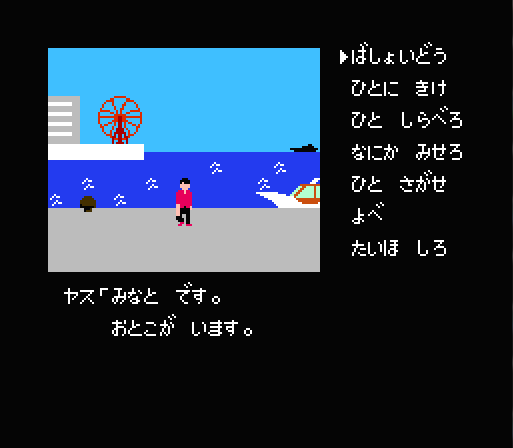 * "Portopia" is a portmanteau that combines the words "port" and "utopia". The word does not originate from the Portopia video game but instead comes from "Portopia '81," also known as the "Kobe Port Island Expo," which was an exhibition held to celebrate the opening of Port Island in 1981 that lasted from March 20th to September 15th [4]. The island is one of the largest man-made islands in the world and is located in Kobe, Japan, the city that the Portopia game mainly takes places in. Due to the name of the exhibition there are also many businesses in and around Port Island that contain the word "portopia" in their name including the Portopia Land amusement park who's ferris wheel can be seen in the distant at the Kobe Port in the Portopia video game [11]. There is even a song performed by the band Godiego called "Portopia" that was created specifically to promote Portopia '81 and was used in the event's commercial.